
Keep the soil where it belongs
Slope & Erosion Control in Detroit, MI
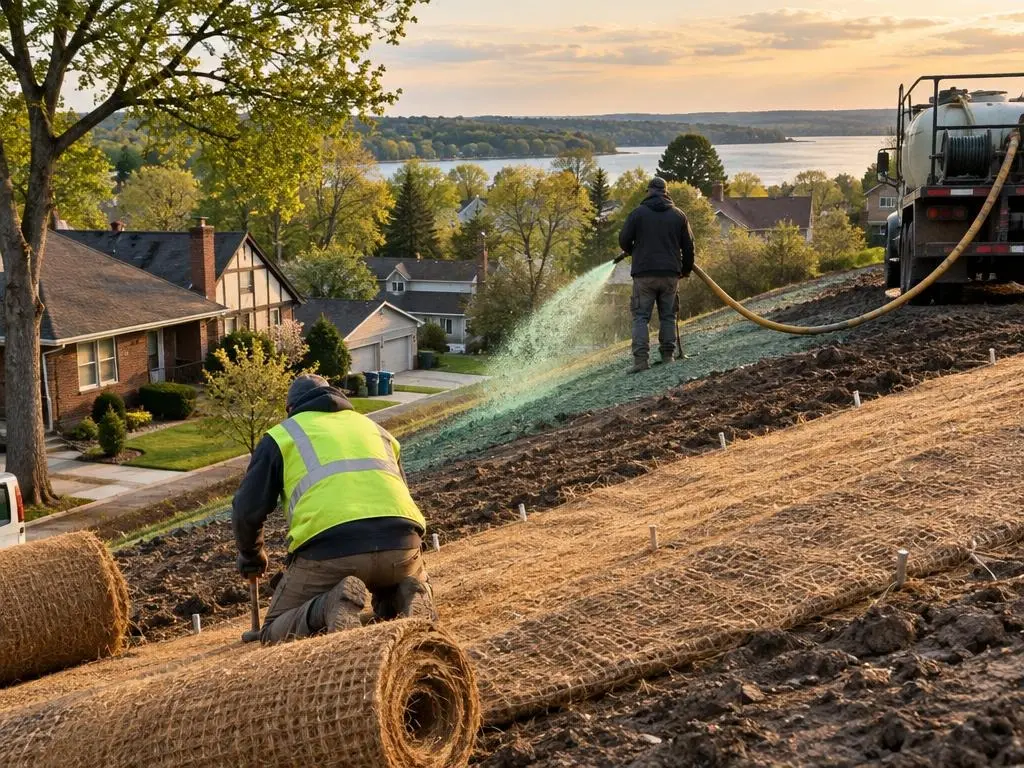
Pinned blankets, heavy hydromulch or bonded fiber matrix for ground that keeps washing out.
- No-charge site visit and an itemized quote
- Seed mixes picked for sun, shade and heavy clay
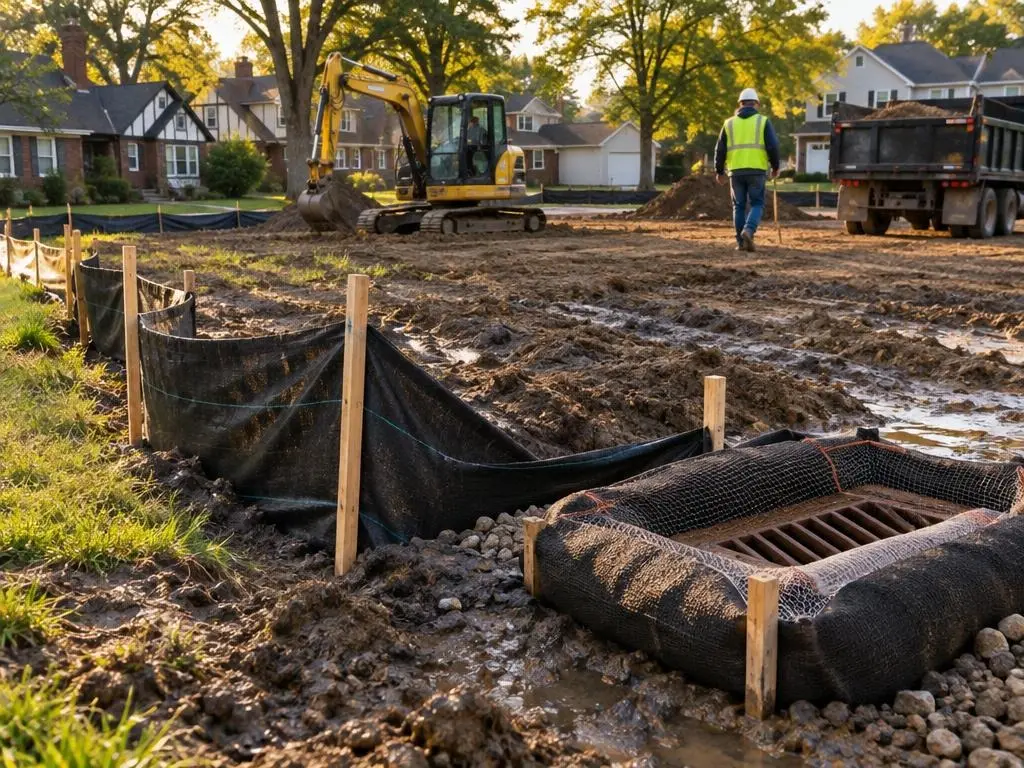
- Silt fence and stabilization set up to match your SESC permit
Holding Soil Through a Michigan Storm Season
Slope and erosion control in Detroit is about getting bare soil through the weeks between seeding and a rooted stand of grass. Thunderstorms are frequent in the Detroit area in spring and summer, and the wettest months on the long-term record are May and June. A single heavy storm on a freshly graded bank can cut rills deep enough to undermine a sidewalk or fill a catch basin with mud. Our erosion control services cover the range of fixes for that problem: heavier hydromulch rates, bonded fiber matrix, erosion control blankets made of straw or coir, and the seeding that eventually takes over the job.
Where we see erosion
The city itself is close to flat, but slope is everywhere at a small scale: walkout basements, banks cut for driveways, berms along parking lots, swales between houses, ditch banks and detention basin sides. North and west of the city the ground gets steeper, with lake lots and moraine hills where a yard can drop several feet to the water. Along the Rouge, Clinton and Huron rivers and their tributaries, banks erode on their own. Clay is part of the problem. It sheds water instead of soaking it up, so runoff builds speed over a short distance and carries fine particles that stay suspended and travel far.
Matching the fix to the slope
Not every slope needs a blanket. Our rough rule of thumb:
- Gentle grades and lawn areas: standard hydroseed with a normal mulch rate and tackifier.
- Moderate slopes and berms: a heavier hydromulch rate, or a bonded fiber matrix (BFM), which sets up as a continuous mat that resists raindrop impact and sheet flow.
- Steep banks, swale bottoms and ditch lines: erosion control blankets pinned to the ground, seeded underneath. Straw blankets suit slopes that will grass over in a season; straw and coconut or all-coir blankets last longer where water concentrates.
- Shorelines and channels: coir products and plantings, coordinated with the permit office, since work within 500 feet of a lake or stream usually needs a soil erosion permit under Michigan's Part 91 rules.
Hydromulch and bonded fiber matrix
Hydro mulching uses the same truck and the same spray as hydroseeding but puts down more fiber per square foot. Bonded fiber matrix adds binders so the fibers lock together into a mat when dry. Both can be sprayed onto slopes that are too steep or too long to blanket easily, and both go on in one pass with seed. They do not replace grading. If water is being directed down a slope by a downspout, a driveway or a neighbor's yard, we fix the flow first.
Blankets
Erosion control blankets come in rolls, are laid from the top of the slope down, trenched in at the top and stapled on a pattern so water cannot get underneath. On clay, staples need to be long enough to hold in soil that softens when wet. Seed goes down before the blanket or is sprayed through it. Straw blankets break down as the grass grows through them, which is usually what a homeowner wants.
Slope stabilization costs
For this kind of work, the useful published prices come mostly from highway agency rate lists, not consumer guides. State road agency rates, 2025, for erosion work put hydraulic wood mulch at $98 for every 1,000 square feet and installed straw-coconut blanket at $468 for every 1,000 square feet. Residential guides add that a steep slope tacks roughly $0.05 to $0.10 onto each square foot of hydroseeding. We quote once we have seen the slope, because length, steepness and access drive the number.
When to call
If you see rills after rain, mulch sliding downhill, bare patches that never fill in, or soil on the sidewalk or in the street after storms, the slope needs more than seed. The earlier we treat it, the less regrading it takes.
Erosion Control Options
We pick the lightest treatment that will hold your slope.
Heavy-rate hydromulch
More fiber per square foot sprayed with seed for moderate grades.
Bonded fiber matrix
A sprayed mat that locks together on steeper or longer slopes.
Straw erosion control blankets
Pinned blankets that protect seed for a season, then break down.
Straw-coir and coir blankets
Longer-lasting blankets for swales, ditch lines and banks.
Swale and ditch stabilization
Shaping the flow line and lining it so water stops cutting it.
Shoreline and bank work
Coir products and seeding, coordinated with the permit office.
Erosion Control Price References
| Item | Published price |
|---|---|
| Wood-fiber hydraulic mulch, each 1,000 sq ft (state road agency rates, 2025) | $98 |
| Blanket, 70% straw / 30% coconut, installed per 1,000 sq ft (same list) | $468 |
| Coconut-fiber (coir) blanket, installed per 1,000 sq ft (same list) | $532 |
| Extra for hydroseeding a steep slope, per sq ft (HomeGuide) | $0.05 to $0.10 |
| Bonded fiber matrix | Quoted once we see the slope |
Rate-list figures come from a public agency, not Detroit quotes. Bonded fiber matrix has no current published price that we could find, so we quote it after measuring. These help you budget; the signed proposal is the real number.
How We Stabilize a Slope
1. Find the water
We trace where runoff comes from and where it is cutting.
2. Fix the flow
Regrade, redirect downspouts or shape a swale if needed.
3. Choose the cover
Hydromulch, BFM or blankets based on steepness and flow.
4. Seed and install
Seed applied with or under the cover, blankets trenched and stapled.
5. Check after storms
We look for rills or lifted edges and repair them early.
Why Choose Us for Slope & Erosion Control
Drainage first
We fix the water source before covering the slope.
Right-sized treatment
Blankets only where they are needed; spray where it will hold.
Permit awareness
We flag work near lakes, streams and drains that likely needs a permit.
Slope & Erosion Control Questions
Do I need erosion control blankets or is hydroseed enough?
On gentle grades, hydroseed with a good mulch rate is usually enough. Steep banks, swale bottoms and ditch lines where water concentrates are where blankets earn their cost.
What is bonded fiber matrix?
A sprayed mulch with binders that dries into a continuous mat. It protects seed on slopes that are hard to blanket and goes on with the same equipment as hydroseed.
Why does my slope keep washing out after I seed it?
Usually because water is being concentrated onto it from a downspout, driveway or upslope yard, or because seed was spread without mulch. We fix the flow and use a heavier cover.
Do I need a permit to stabilize my lakefront bank?
Work within 500 feet of a lake or stream often needs a soil erosion permit, and the trigger size varies by county. Check with your local enforcing agency before work starts; we can help you find it.
Will the blanket have to be removed later?
Straw blankets break down as the grass grows through them. Coir lasts longer and is meant to stay in place.
Slope & Erosion Control Service Areas
- Hydroseeding in Detroit, MI
- Hydroseeding in Novi, MI
- Hydroseeding in Canton, MI
- Hydroseeding in Troy, MI
- Hydroseeding in Rochester Hills, MI
- Hydroseeding in Sterling Heights, MI
- Hydroseeding in Macomb Township, MI
- Hydroseeding in Shelby Township, MI
- Hydroseeding in Independence Township, MI
- Hydroseeding in Orion Township, MI
- Hydroseeding in Commerce Township, MI
- Hydroseeding in West Bloomfield, MI
- Hydroseeding in Livonia, MI
- Hydroseeding in Farmington Hills, MI
- Hydroseeding in Northville Township, MI
- Hydroseeding in Chesterfield Township, MI
- Hydroseeding in Clinton Township, MI
- Hydroseeding in Washington Township, MI
- Hydroseeding in Lyon Township, MI
- Hydroseeding in White Lake Township, MI
- Hydroseeding in Brownstown Township, MI
- Hydroseeding in Grosse Ile, MI
Get a Slope & Erosion Control Estimate
Free slope and drainage assessments across Metro Detroit.